If you want a useful quote for 100% cotton custom tea towels, the best starting point is not a perfect technical brief. It is a clear project story.
Are you an artist turning one illustration into a shop product? A gift store planning a local souvenir range? A cafe testing branded merchandise? A school collecting drawings for a fundraiser? A small brand preparing a launch gift?
Those projects may all use custom printed cotton tea towels, but the quote questions are not exactly the same. Quantity, artwork detail, packaging, sample needs, and delivery country can all change the conversation.
When customers contact us, the fastest quotes usually come from short, practical messages. The slower ones are often missing one or two simple details, so both sides have to go back and forth before the real work can start.
This FAQ is written for designers, artists, gift shops, small brands, schools, cafes, and event teams who want to prepare a better quote request before ordering 100% cotton custom tea towels.
Short Answer: What Should You Send First?
Send enough information for the supplier to understand what the towel is for, how it will be printed, and where it needs to go.
A good first message usually includes:
- Your project type
- Your artwork or draft design
- Expected quantity or quantity range
- Preferred tea towel size
- Fabric preference, such as 100% cotton
- Number of designs
- Print method preference, if you already know it
- Packaging needs
- Delivery country and city
- Any important date
- Whether you need a sample first
You do not need to know every answer before asking. But if you can send even a rough version of those details, the quote conversation becomes much more useful.
| Detail | Why it matters |
|---|---|
| Project type | Helps match the quote to retail, gifting, fundraising, or brand use |
| Artwork | Affects print method, detail check, colors, and layout advice |
| Quantity | Changes the production and price conversation |
| Size | Affects fabric use, artwork ratio, and presentation |
| Packaging | Matters for gift shops, artist products, and online orders |
| Delivery country | Needed for shipping discussion and timing expectations |
| Deadline | Helps decide whether sampling or revisions need to move faster |
If you only have a loose idea, say that. A supplier can usually help you shape the next step, as long as the project context is honest.
What Changes The Quote For 100% Cotton Custom Tea Towels?
The biggest mistake is assuming the quote is based only on one number: quantity.
Quantity matters, of course. But for custom tea towels, the quote can also be affected by the artwork, towel size, fabric, print method, finishing, packaging, sample request, and delivery location.
For design-led projects, we usually pay attention to:
- Whether the artwork is simple or detailed
- Whether the design uses many colors
- Whether small text needs to stay readable
- Whether the towel will be sold folded or displayed open
- Whether packaging is needed for retail presentation
- Whether there is one design or several designs
- Whether the order is a first test run or a repeat product
For example, an illustrator planning one detailed design for a shop product may need a different conversation from a school preparing a large class drawing layout. A cafe logo towel may be more straightforward, but packaging and brand color can still matter.
This is why "How much for tea towels?" is hard to answer well. "I am an artist planning 100% cotton custom tea towels from one full-color illustration, possibly 100 to 300 pieces, with delivery to Canada" is much easier to work with.
Do I Need Finished Artwork Before Asking?
Not always.
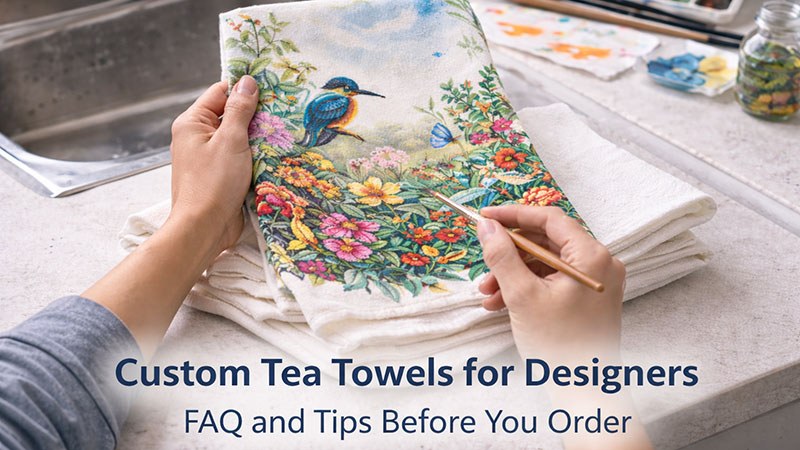
If your artwork is finished, send it. If it is not finished, send the closest draft you have and explain what may still change. A draft is often more useful than a long description with no visual reference.
For custom printed cotton tea towels, artwork affects several practical checks:
- Print size
- Layout ratio
- Color expectation
- Edge margins
- Small text
- Line thickness
- Folded presentation
- Whether the design suits digital printing
We often check whether the artwork will still make sense on fabric, not only on a screen. Cotton has texture. A thin line, tiny signature, or pale color may behave differently once printed.
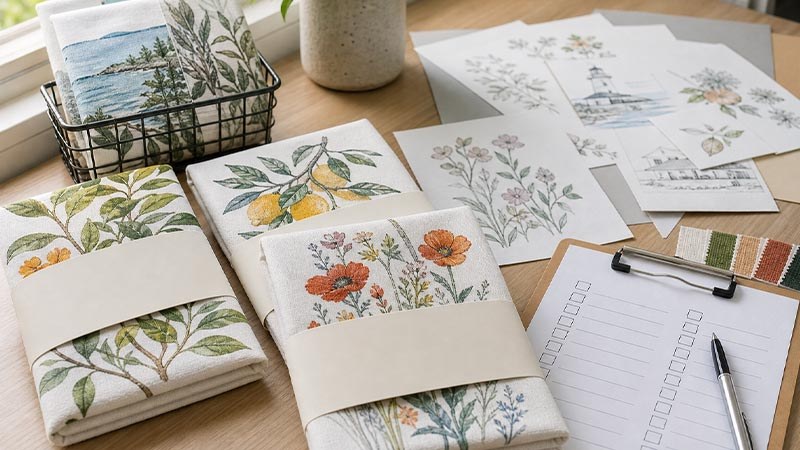
If the tea towel will become a retail product, look at the design in two ways: fully open and folded. A beautiful full layout may still need a strong visible area for a shelf, basket, belly band, or online product photo.
For detailed artwork, the custom digital printed tea towels page is usually a helpful reference point, because digital printing is often considered when artwork includes multiple colors, illustration detail, or softer tonal changes.
How Should I Describe Quantity?
If you know the exact quantity, include it. If not, give a range.
For a first product test, it is normal to be unsure. You might say:
- "We are considering 100 to 200 pieces for a first artist product."
- "Our gift shop wants to test one local design first."
- "We are collecting interest from school families and need advice on quantity."
- "We may reorder if the first design sells well."
That kind of range helps the supplier understand the stage of the project.
It is also useful to mention whether you are planning one design or several designs. Five designs at a smaller quantity each is different from one design at a larger quantity. A range can still be enough for an early quote conversation, but the number of designs should not be hidden.
If you are comparing options, say so clearly. There is nothing wrong with asking for two quantity levels if you are still planning. Just keep it practical so the quote does not become a spreadsheet of guesses.
What Size Should I Choose?
If you already have a preferred size, include it. If not, tell the supplier how the towel will be used or sold.
A tea towel for a gift shop, artist range, cafe merchandise item, or school fundraiser needs to feel practical as a kitchen textile, but also attractive as a printed product. Size affects both.
Useful questions to ask yourself:
- Will the design be sold folded?
- Does the artwork need a large open area?
- Will there be names, maps, or small captions?
- Does the towel need to fit existing packaging?
- Will it be photographed for online sales?
- Is this a one-off gift or a repeat retail product?
For many projects, 100% cotton gives a familiar, useful base. The final size should support both the artwork and the way the buyer will see the product.
Should Packaging Be Included In The First Quote Request?
Yes, if packaging matters to the final product.
Packaging is sometimes treated as an afterthought, but it can change the quote and the planning conversation. For artists, gift shops, small brands, museum shops, cafes, and tourist products, packaging is part of how the tea towel is sold.
Common packaging questions include:
- Do you need a belly band?
- Do you need a hang tag?
- Will each towel be individually packed?
- Will the towel be sold folded or hanging?
- Do you need a simple card or insert?
- Is packaging needed for online orders?
For a school fundraiser or community project, packaging might be simple. For a retail product, it may be one of the details that makes the towel feel ready for a shop shelf.
Do I Need A Sample?
Sometimes, yes.
A sample is especially worth discussing when color, artwork detail, fabric feel, or retail presentation matters. It can be helpful for:
- Artist products
- Gift shop ranges
- Museum or gallery shop items
- School tea towels with many names or drawings
- Designs with small text
- Products that may be reordered
- Brand color projects
A sample is not only about checking whether the towel exists. It helps you review the artwork on cotton, the printed color, the level of detail, the fold, and the overall product feeling.
If your deadline is tight, mention that early. Sampling can be useful, but it also needs time. We avoid promising timing before project details are reviewed, because every project has its own artwork, quantity, and delivery situation.
What Delivery Details Should I Include?
At minimum, include the delivery country and city.
For international projects, delivery location is part of the quote conversation. It helps avoid vague answers and makes it easier to discuss the next step. If you have an event date, shop launch, school fundraiser deadline, or market date, include it in the first message.
Useful wording:
"Delivery would be to Sydney, Australia, and we hope to have the towels ready before an October shop launch."
Or:
"We are in the UK and still flexible on timing, but we would like to understand quote options before finalizing the artwork."
Both messages are helpful because they give context without demanding a promise before the project is checked.
What Should I Avoid In A Quote Request?
Avoid sending only the shortest possible question with no project context.
These are hard to answer well:
- "Price?"
- "MOQ?"
- "How much for tea towels?"
- "Can you print my design?"
They are not bad questions. They are just incomplete.
Better versions:
- "What information do you need to quote 100% cotton custom tea towels for one artist design?"
- "Can you advise on quantity and packaging for a small gift shop order?"
- "I have a school artwork layout and need to check if the names will print clearly."
- "We are planning custom printed cotton tea towels for a cafe and want to compare quantity options."
A quote request should make the next reply easier, not longer.
A Simple Quote Request Template
You can adapt this:
"Hi BLANC Tea Towel, I am planning 100% cotton custom tea towels for [artist product / gift shop / school fundraiser / cafe merchandise / event gift / small brand project].
I have [finished artwork / draft artwork / a design idea] and I am considering [quantity or quantity range]. The delivery location is [city, country]. I am interested in [digital printing / artwork advice / packaging / sample / size guidance]. The tea towels will be used for [retail sales / gifting / fundraising / event / brand merchandise].
Could you please advise what information you need for a quote?"
This is short, but it gives enough context to start a real conversation.
How BLANC Tea Towel Can Help
BLANC Tea Towel works with custom tea towels for designers, artists, gift shops, schools, cafes, events, and small brands.
For quote preparation, we can help review:
- Artwork suitability
- 100% cotton fabric direction
- Digital printing needs
- Finished size
- Quantity planning
- Packaging options
- Sample questions
- Delivery country and timing details
If you are not sure what to send, start with your artwork or draft idea, quantity range, delivery country, and how the tea towels will be used or sold. That is enough to begin a clearer quote conversation.
Next Step
Preparing a quote request for 100% cotton custom tea towels?
Send BLANC Tea Towel your artwork or draft, expected quantity, preferred size, packaging needs, delivery city and country, and a short note about how the towels will be used. We can review the details and help you move from idea to quote-ready project.
Start here: Custom Tea Towels
FAQ
What is the most important detail to send before asking for a tea towel quote?
The most useful first details are your artwork or draft, expected quantity, towel size, fabric preference, packaging needs, delivery country, and the intended use of the tea towels.
Can I ask for a quote before my artwork is finished?
Yes. A draft can still help start the conversation. Send the closest version you have and explain what may still change, especially if colors, small text, or layout are not final.
Does quantity affect the quote for 100% cotton custom tea towels?
Yes. Quantity is important, but it is not the only factor. Artwork detail, size, fabric, printing method, packaging, sample needs, and delivery location can also affect the quote.
Should packaging be included in the quote request?
If the tea towels will be sold, gifted, or packed for online orders, packaging should be mentioned early. Belly bands, tags, insert cards, or individual packing may affect the planning and quote.
Do I need a sample before ordering custom printed cotton tea towels?
A sample is worth discussing if color, fabric feel, small text, artwork detail, or retail presentation matters. It is especially useful for artist products, gift shop ranges, school projects, and repeat products.