For a school tea towel project, the most stressful mistake is often not a printing issue. It is finding a misspelled name, a missing drawing or the wrong class detail after everyone believed the artwork was final.
A good proofing process gives the organiser one calm, repeatable way to check the final design before approval. It does not need to turn a class project into a technical exercise. It simply separates the creative work from the last accuracy check, so a custom printed cotton tea towel can still feel personal when it reaches families.
Give one person responsibility for the final list
Before the artwork is placed into its final layout, nominate one person to own the approved class information. This can be a teacher, a parent-group volunteer or the person coordinating the project. Their job is not to redesign the towel; it is to hold the reference list against which the proof will be checked.
That reference should include the class name, year, school spelling, staff names if they are being included, and the agreed version of every childâs name. If a child is represented by a drawing but no name, note that too. A clear source list is much easier to check than a chain of emails, handwritten notes and changed files.
It also helps to decide early how names will appear. Typed names, handwritten names and names paired with drawings all need a different review. Whichever approach you choose, keep it consistent enough that a parent can recognise the result without having to decode the layout.
Check the proof in two passes
Trying to inspect everything at once is where small errors slip through. We find it is more practical to make two passes.
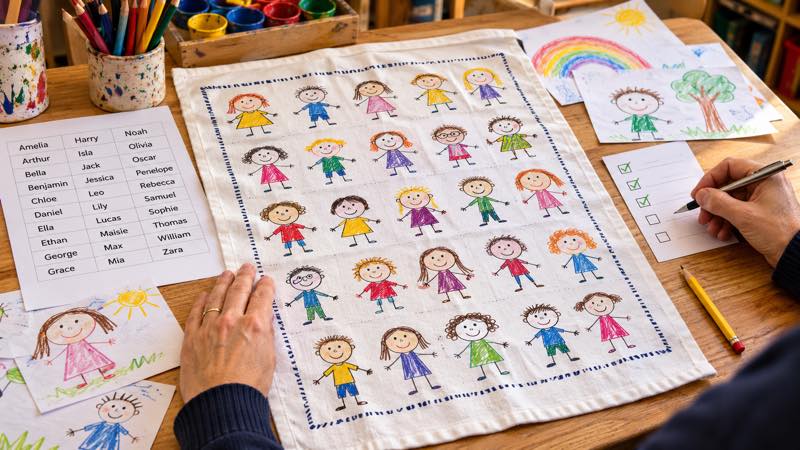
The first is the content pass. Compare the proof to the approved list and ask: is every name present, spelled as agreed and attached to the right drawing or place in the design? Check school name, class, year and any short message separately. Read them aloud if that helps; a familiar word can look correct even when one letter is missing.
The second is the layout pass. Put the proof aside for a moment, then look at it as a tea towel rather than a document. Are the names large enough to be found? Are any drawings too close to the edge? Does a border interrupt a name? Is there a crowded area where two childrenâs work appears to merge? This pass catches problems that a name-by-name check cannot.
If you are still deciding how the artwork should sit on the cloth, our school tea towels page is a useful starting point for the wider project.
Keep drawings and names connected
Childrenâs drawings are often meant to keep their own character. That is part of the charm. The proofing job is not to make them uniform; it is to make sure the final arrangement remains understandable.
For a grid, check each square or row against the source list. For a more playful collage, use a numbered working copy for the organiser only, then remove those working marks from the final art. If names are handwritten, compare them against the approved spelling list rather than trying to guess from the handwriting. If names are typed, check that a late correction has not created a different font size or a line that now sits too close to a drawing.
It is worth viewing the proof at its intended scale, not only zoomed in on a laptop. A detail can look generous at 200% and feel very small once it becomes part of a full tea towel. The aim is simple: each family should be able to find the part of the project that matters to them.
Build in a short correction window
Proofing works best when it has a clear beginning and end. Send the proof to the people who genuinely need to check it, state what they should look for, and set one final time for corrections. An open-ended review can create confusion, especially if several people are editing different copies.
Ask reviewers to report a correction in a useful format: the current spelling or location, the requested change, and the source that confirms it. That is far easier to action than a message saying that something âlooks wrongâ. Once corrections are collected, the nominated organiser should approve one final version. This protects the project from a second round of accidental changes after the proof has already been checked.
Do not confuse a proof with a physical sample
A proof is mainly for checking names, layout, placement and the agreed artwork. It is the best place to catch a missing child, an outdated class year or a title that has shifted too close to an edge.
A physical sample, when it is appropriate to discuss, answers a different set of questions: how the cotton feels, how the artwork scale reads on fabric, and how the finished tea towel might be presented. It should not replace careful proofreading. Even a beautiful sample cannot fix a name that was never checked in the file.
For projects with detailed drawings, multiple colours or fine lines, you can also explore our custom digital printed tea towels page before discussing the artwork direction.
A practical final-proof checklist
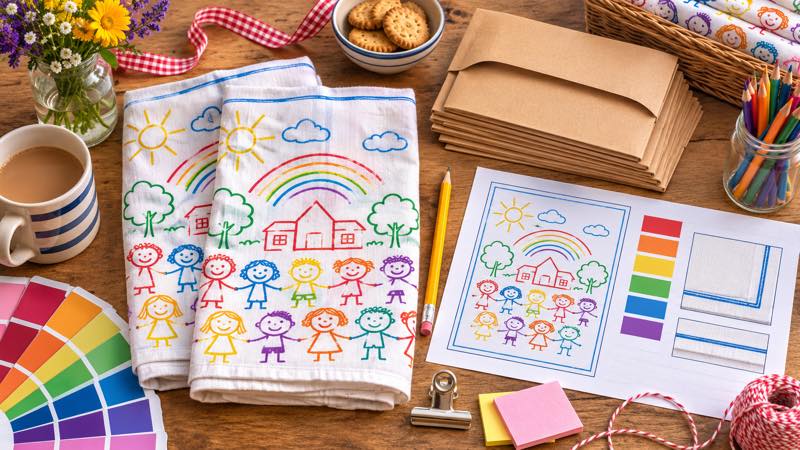
Before approving the artwork, ask the final reviewer to confirm:
- Every agreed child name is present and spelled correctly.
- The school, class, year and staff details use the approved wording.
- Names still have enough space around drawings, borders and edges.
- Each drawing is present in the intended place.
- No duplicate, placeholder, temporary note or outdated version remains.
- The design has been checked at a realistic viewing size, not only zoomed in.
- One person has approved the final file after corrections were made.
This is not about making the artwork overly formal. It is a small piece of care that helps a class keepsake or fundraiser feel complete.
What to send when you are ready to talk
You do not need every production decision settled before getting in touch. A useful first message can include a draft proof or artwork preview, the number of classes or designs, an approximate quantity, the delivery country, and a note on whether names are included. If there is an event or school date in view, mention that as context without assuming a delivery promise.
If you are planning a school tea towel project, send BLANC Tea Towel your artwork preview, approved-name approach, approximate quantity and delivery country through our contact form. We can help you identify the practical details to clarify before the final artwork is approved.
FAQ
Who should approve the final school tea towel proof?
Choose one named organiser to give the final approval after the teacher or parent group has checked names and class details. A single approval point makes it less likely that different versions will be used.
Should names be typed or handwritten on a school tea towel?
Either can work. Typed names are often easier to check for consistency, while handwritten names can keep a more personal feel. The important part is to compare the final proof with an approved spelling list.
What should be checked first on a proof?
Start with names, school details and the class year. Then make a separate pass for spacing, edges, drawing placement and overall readability.
Can we ask for a quote before every name is final?
Yes. A draft layout and approximate project information can start a conversation. Be clear about what is still being checked so the final artwork review can happen at the right stage.