Your first custom product order can feel oddly bigger than it looks on paper.
Maybe you are an illustrator who wants to turn one strong piece of artwork into a useful product. Maybe you run a gift shop and want a local design that customers can take home. Maybe you are planning a cafe opening, a school fundraiser, a museum shop item, or a small seasonal collection.
In all of those situations, 100% cotton custom tea towels can be a practical place to start. They are useful, easy to explain, giftable, and suitable for artwork-led designs. But the first order still needs a clear plan. If the artwork, size, quantity, fabric, packaging, and deadline are vague, the quote will be vague too.
This 100% cotton custom tea towels use case guide walks through how to think about a first order without overcomplicating it.
Start With The Use Case, Not The Quantity
When people contact us about custom tea towels, they often start with the question: “How many should I order?”
Quantity matters, of course. But for a first custom product order, the better starting question is: “What should this tea towel do?”
The answer changes the whole project.
| Use case | What matters most |
|---|---|
| Artist or illustrator product | Artwork detail, color, cotton texture, sample approval |
| Gift shop item | Local relevance, retail display, packaging, reorder potential |
| Museum or gallery shop product | Artwork permission, color control, presentation |
| Cafe or food brand merchandise | Logo placement, brand feel, useful size |
| School or community project | Clear artwork collection, readable names or drawings, deadline |
| Event gift | Simple brief, delivery country, packing method |
If you are planning your first order, do not rush past this step. A tea towel for a gallery shop and a tea towel for a school fundraiser may both be cotton, rectangular, and printed, but the decisions behind them are different.
For an artist, the design may be the product. For a gift shop, the product has to look good on a shelf. For a cafe, the tea towel should feel useful and branded without looking like a disposable giveaway.
That is why the use case should come before the quantity.
Why 100% Cotton Is A Sensible First Product Choice
For many design-led projects, 100% cotton is a good starting point because people already understand the object. A tea towel belongs in a kitchen, a shop, a gift box, a studio sale, or a local market stall without needing much explanation.
Cotton also gives artwork a more tactile feeling than paper. The final piece is not just an image. It becomes something people can use, fold, hang, gift, or collect.
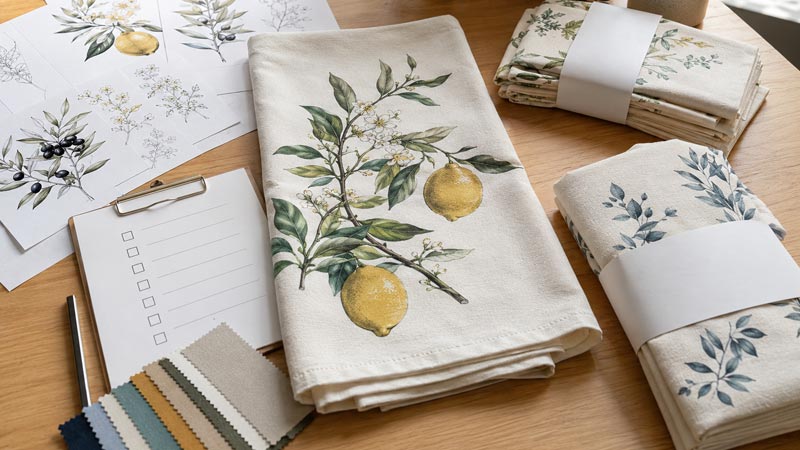
For colorful artwork, custom digital printed tea towels are often useful because digital printing can work with illustrations, repeat patterns, maps, botanical art, watercolor-style artwork, and multi-color designs. The artwork still needs to be prepared properly, but the design does not have to be reduced to one simple color.
If this is your first product, 100% cotton custom tea towels are also easier to test than many large home textile items. They are compact, familiar, and suitable for a single hero design or a small set of designs.
Decide What Your First Order Needs To Prove
A first order does not need to prove everything. It should answer the most important question for your project.
For an artist, the first order may need to prove that the artwork works well on fabric. For a gift shop, it may need to prove that customers respond to the design. For a cafe, it may need to prove that the product feels useful enough to sell or gift. For a school project, it may need to prove that collected drawings or names can be arranged clearly.
Before asking for a quote, write one sentence that describes what you are testing:
- “I want to see whether my illustration works as a sellable tea towel.”
- “I want to create a local souvenir product for our shop.”
- “I want a practical branded item for our cafe opening.”
- “I want a school keepsake that families will actually use.”
- “I want to test two designs before planning a bigger seasonal range.”
This sentence may seem simple, but it helps. It keeps the first order focused and makes it easier for a supplier to understand what advice is useful.
What To Prepare Before Asking For A Quote
You do not need every detail finalized before the first conversation. But you should prepare enough information for a meaningful quote.
Before requesting pricing, try to gather:
- Artwork file or draft design
- Expected quantity or quantity range
- Preferred finished size, if known
- Fabric preference, such as 100% cotton
- Whether the design is full-color or simple-color
- Packaging idea, if the tea towel will be sold or gifted
- Delivery country
- Any important deadline
- How the tea towel will be used, sold, or presented
If you are unsure about size, quantity, or packaging, say that. A clear uncertainty is better than a guessed specification.
For example, “I am an illustrator planning my first tea towel product and I am not sure whether to start with one design or two” is useful context. So is “We are a gift shop and need something that can sit folded on a shelf.”
The more human the brief is, the easier it is to guide the technical details.
Artwork Decisions That Affect The Finished Product
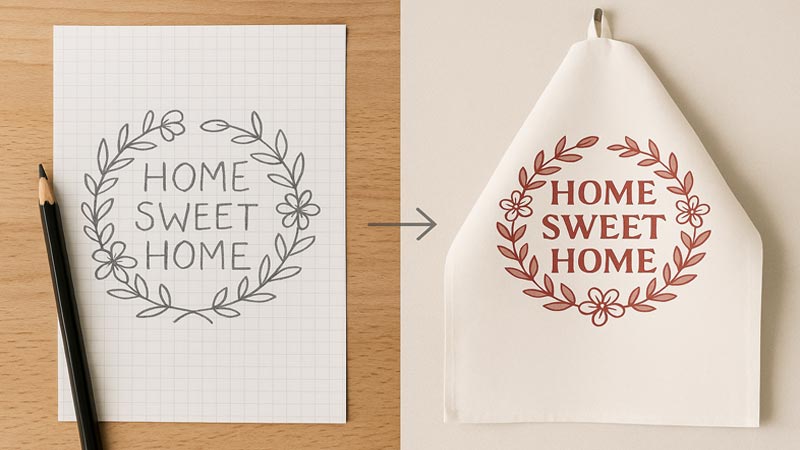
Artwork that looks good on a screen may need adjustment before it becomes a printed cotton tea towel.
We usually look at practical details such as:
- Image resolution
- Finished print size
- Artwork ratio
- Edge margins
- Small text
- Thin lines
- Color expectations
- Whether the artwork still works when folded
If your artwork has lettering, signatures, small place names, map details, or delicate linework, those areas deserve extra attention. Cotton has texture, and fine details can soften compared with a digital screen or paper print.
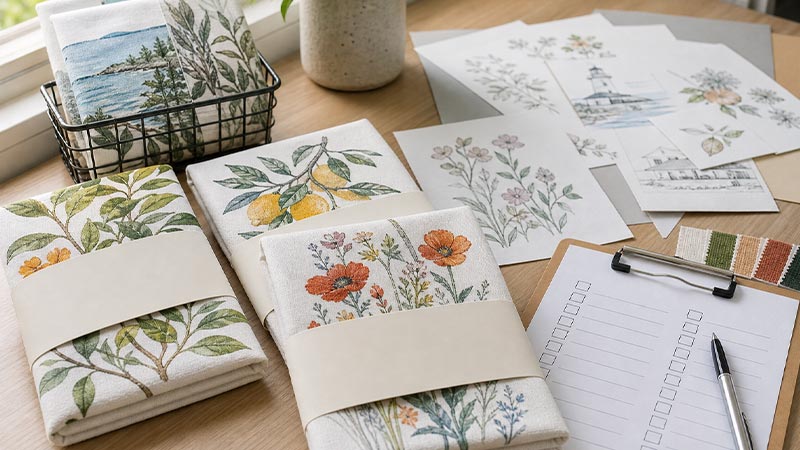
One common first-order mistake is treating the tea towel like a flat poster. It is not only viewed fully open. It may be folded, stacked, hung, photographed, wrapped with a belly band, or displayed in a basket. A design that looks beautiful as a full rectangle should also have enough visual interest when partly folded.
That is especially important for designer tea towel projects, where the product has to carry the artist’s style and still feel practical.
Quantity: Start With A Realistic First Step
For a first order, quantity is partly about price and partly about confidence.
A larger order can lower the unit cost, but it also means more stock to sell, store, pack, or distribute. A smaller order can be easier to test, but the unit cost is usually higher. There is no single correct answer because the right quantity depends on the use case.
Think about:
- How many people already know about the product
- Whether the design has been tested with customers
- Whether the tea towel will be sold online, in-store, or at an event
- Whether you expect reorders
- Whether one design or several designs should share the budget
- How much inventory risk feels comfortable
If you are an artist, one strong design may be better than five rushed designs. If you run a gift shop, a small group of local designs may make sense if each has a clear audience. If you are planning a school or event project, the quantity may be tied more directly to participant numbers.
The goal is not always to make the first order as large as possible. The goal is to make it useful enough to learn from.
Packaging Is Part Of The Use Case
Packaging is easy to treat as a later detail, but it can change how the product works.
A tea towel sold in a gift shop may need a belly band, hang tag, insert card, individual bag, or folded presentation. A tea towel sent as an event gift may need simpler packing. A tea towel sold online may need to photograph well when folded.
If packaging matters, mention it early. It can affect the quote and the preparation process.
For retail projects, think about how the customer first sees the product:
- Hanging open
- Folded on a shelf
- Stacked in a basket
- Wrapped with a belly band
- Packed with a card
- Shipped as an online order
The same artwork can feel very different depending on presentation. A beautiful full-size design may need a visible label or a strong folded section so it still makes sense before the customer opens it.
Samples And Color Expectations
If this is a first order and the result really matters, a sample can be a sensible step.
This is especially true when:
- The artwork has important color details
- The design includes small text
- The tea towel will be sold as an artist product
- The project may lead to reorders
- The customer needs to approve fabric feel
- The product will be displayed in a shop
A digital mockup is useful, but it is not the same as a printed cotton tea towel. Screens are backlit. Cotton has texture. Colors can shift slightly from screen to fabric. Fine details can behave differently once printed.
We do not recommend treating a mockup as the final proof of color or fabric feel. It is a planning tool, not the finished object.
A Simple First-Order Brief You Can Send
If you want to make the inquiry process easier, send a short brief like this:
“Hi BLANC Tea Towel, I am planning my first custom cotton tea towel order. The use case is [artist product / gift shop item / cafe merchandise / school project / event gift]. I have [one design / several designs / draft artwork]. I am thinking about [quantity or quantity range], [size if known], and delivery to [country]. I would also like advice on [packaging / sample / artwork setup / quantity].”
That kind of message gives us enough context to start a useful conversation. It also makes it easier to avoid generic answers.
If you already have artwork, include it. If the artwork is not final, send the closest draft and explain what may change.
How BLANC Tea Towel Can Help
BLANC Tea Towel works with custom printed cotton tea towel projects for designers, artists, gift shops, small brands, schools, events, and other design-led projects.
For a first order, we can help review the basic production questions:
- Does the artwork suit a cotton tea towel?
- Is the file large enough for the intended print size?
- Does the layout need more margin?
- Is the design better as one hero product or part of a small set?
- Does the project need simple packing or retail-ready packaging?
- Should a sample be considered before a larger order?
- What details are needed before quoting?
We cannot make the product plan for you without the project context, but we can help turn the idea into a clearer production brief.
Next Step
Planning your first 100% cotton custom tea towel order?
Send us your artwork or draft idea, expected quantity, preferred size, packaging needs, delivery country, and how the tea towel will be used. We can review the details and help you prepare the next step for a clear quote.
Start here: Custom Tea Towels
FAQ
Are 100% cotton custom tea towels a good first product for artists?
Yes, they can be a practical first product because they are useful, giftable, compact, and suitable for artwork-led designs when the file is prepared properly.
What should I decide before requesting a quote?
Start with the use case, artwork status, expected quantity, preferred size, fabric preference, packaging needs, delivery country, and any important deadline.
Should I order one design or several designs first?
For many first orders, one or two strong designs are easier to test than a large group of unproven designs. The right choice depends on your audience, budget, and selling plan.
Do I need retail packaging for a first tea towel order?
Not always. If the tea towels will be sold in a shop or online, packaging can help the product feel ready to buy. If they are for an internal event or simple gift, simpler packing may be enough.
Should I request a sample before production?
If color, fabric feel, small text, or retail presentation is important, a sample is worth considering before a larger order.