White cotton is often the most useful starting point when an artwork-led tea towel needs to feel clear, considered and easy to read. It gives line work, colour, lettering and deliberate empty space somewhere clean to sitâwithout asking the artwork to compete with a coloured ground.
That does not make white cotton a blank, risk-free choice. On a functional textile, the design still needs enough contrast, the right scale and a layout that works when the towel is folded. For artists, illustrators, gift shops and small brands, those choices usually matter more than whether a design simply looks busy or bright on screen.
Why White Cotton Is a Helpful Starting Point
For custom printed cotton tea towels, a white base can make the design feel more direct. A detailed drawing has room to breathe. A repeat pattern can keep its rhythm. A colourful illustration can show its intended palette without an extra background colour shifting the overall impression.
White also gives a practical reference point when you are reviewing artwork. It is easier to see whether a pale line is really visible, whether a border is doing useful work, and whether a small piece of lettering still belongs at the intended size.
The best result is not necessarily the loudest one. A white tea towel can suit a bold, full-coverage print just as well as a quiet illustration with large areas of open fabric. The useful question is whether the visual hierarchy still makes sense once the design becomes a textile product.
Artwork Styles That Often Work Well
Fine line illustration with a clear focal point
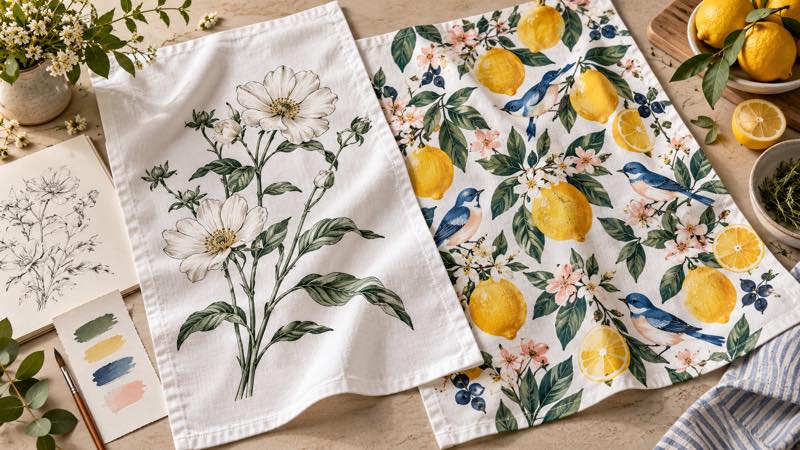
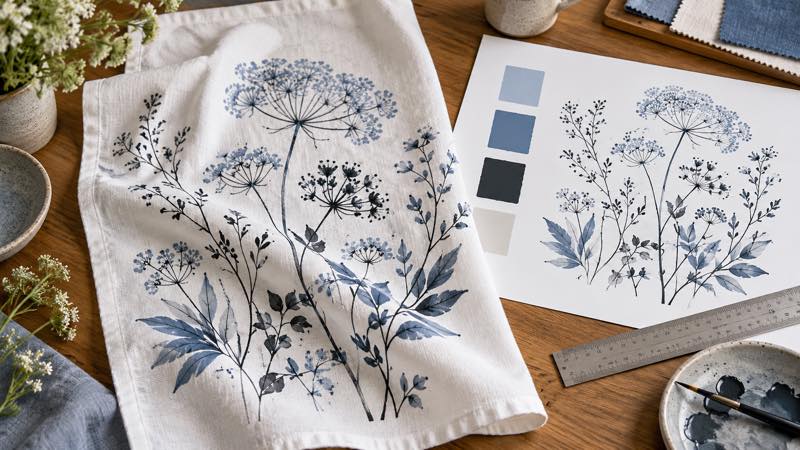
Botanical drawings, maps, hand-drawn buildings and food illustrations can look especially at home on white cotton when the important lines are distinct enough from the background. A single dark ink colour, a small palette or a few strong accents can often be more readable than many nearly identical tones.
If a drawing includes a signature, place name or small label, view it at the intended towel size before treating it as final. It is easy to judge a line as clear when zoomed in on a screen.
Repeat patterns with intentional breathing room
White space is not unused space. In a repeat pattern, it can separate motifs, stop colours from merging visually and make the printed towel feel less crowded when it is hanging or folded on a shelf.
A pattern does not need to be sparse. It simply needs a rhythm that still reads from a normal viewing distance. If every motif is tiny, or every gap depends on a very pale colour, the pattern may need a more careful artwork check.
For projects with detailed illustration, our custom digital printed tea towels page is a useful place to start when considering how the artwork, fabric and print approach fit together.
Colourful illustrations with a light background
White cotton can support colourful artwork without making the whole product feel heavy. This can work well for children's illustrations, artist merchandise, cafe designs, museum shop ranges and gift-shop products where the illustration should remain the centre of attention.
Rather than filling every part of the towel by default, look at where the eye should go first. A colourful central illustration, a border of smaller motifs or a large repeat can all work. The important part is that the light background is a design decision, not an accidental empty area.
What Needs Extra Care on a White Ground
White cotton can make dark details look crisp, but it also makes uncertain choices easier to notice. Check pale yellow, cream or light grey details; fine lines; white elements inside the artwork; very small text; borders too close to the edge; and layouts that lose their focal point when folded.
If an element matters to the story of the artwork, give it enough contrast to remain visible. That may mean a darker outline, a slightly stronger colour, a clearer separation between motifs or a change in scale. It does not mean every design needs to become high contrast everywhere.
Think About the Finished Product, Not Only the File
An artwork file can look complete long before the product idea is complete. A tea towel may be displayed open, folded into a belly band, hung from a rail, packed as a gift or photographed for an online shop. Each setting changes which part of the design is visible first.
Gift shops often benefit from a design that has a recognisable detail in the folded view. Artists may want a signature motif visible near the top fold. A small brand may need to decide whether its logo belongs inside the illustration, on a label or in a separate packaging element.
This is why a full mock-up is helpful even when the artwork itself is finished. It can reveal a beautiful section that is hidden by the fold, or an area of white space that becomes useful room for a label.
For broader decisions about fabric, artwork, packaging and project scope, see our custom tea towels page.
A Short White-Cotton Artwork Review
Before you request a quote, take one last look at the design on a white background and at roughly the size you expect to print.
- Is the main illustration or pattern immediately clear?
- Do pale details still have a purpose and enough visibility?
- Are tiny words, names and dates genuinely readable?
- Does the composition work both fully open and folded?
- Is white space supporting the design rather than appearing accidental?
- Have you noted the number of designs, approximate quantity, packaging idea and delivery country?
This check is not about making every tea towel look the same. It is about giving the artwork the best chance to feel intentional on cotton.
If you are considering white cotton tea towels for a digital print project, send BLANC Tea Towel a preview of the artwork, the best available file, the number of designs, approximate quantity, intended use and delivery country through the contact form.
We can help identify which details are worth clarifying before you move from an artwork file to a custom printed cotton tea towel.
FAQ
Are white cotton tea towels suitable for colourful artwork?
Yes. A white base can help colourful illustration remain the focus, especially when the palette, contrast and scale are planned for cotton fabric rather than only for a screen.
Can pale artwork work on a white tea towel?
It can, but essential pale details need careful review. If a pale line, name or motif carries important information, it may need more contrast, a clearer edge or a larger scale.
Is white space a problem in a tea towel design?
Not when it is intentional. White space can separate motifs, make line work easier to read and leave room for a design to feel balanced when the towel is folded or displayed.
What should I send for a white cotton tea towel quote?
Send an artwork preview and best available file, plus the number of designs, approximate quantity, intended use, packaging idea if relevant and delivery country.